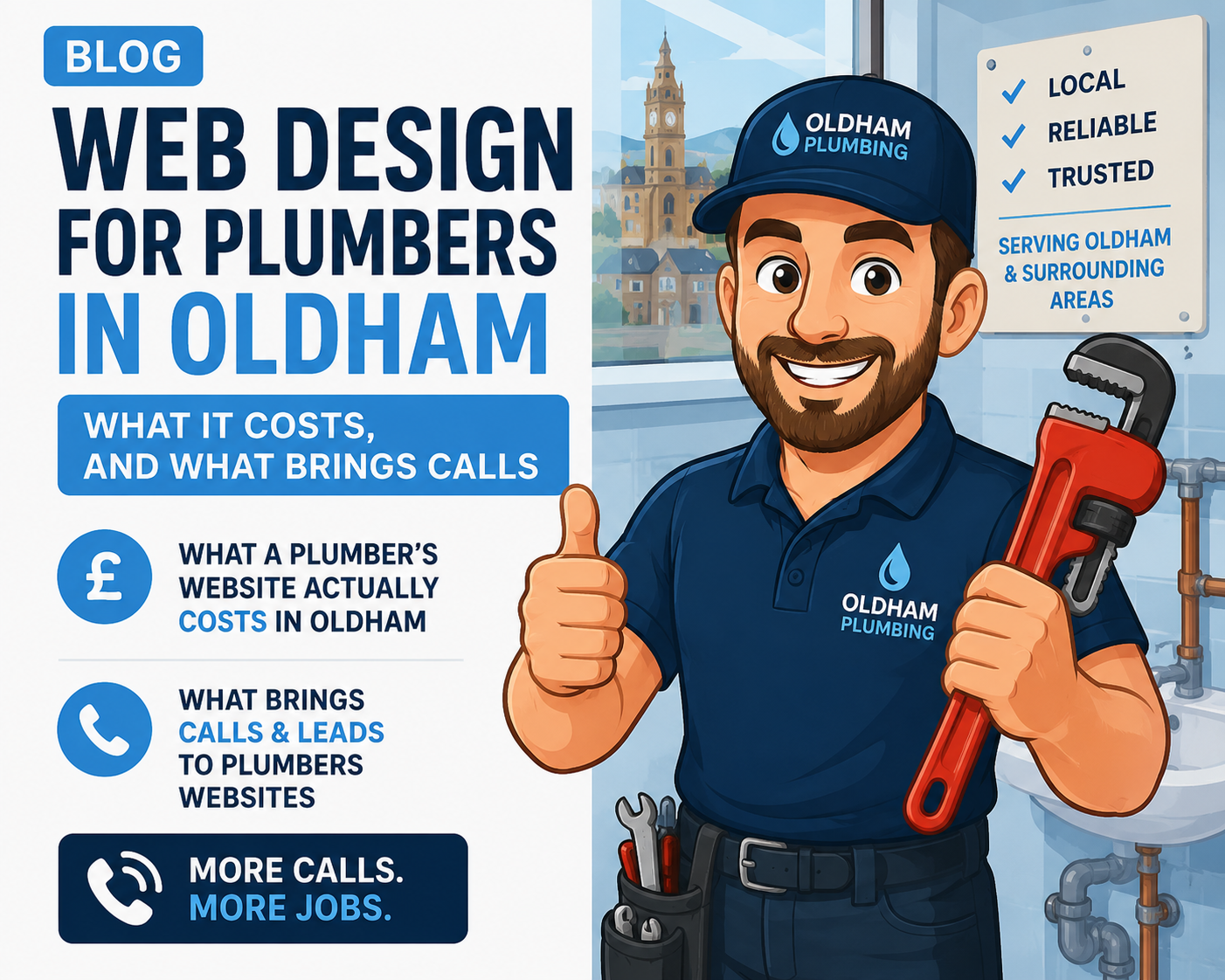
You're a plumber in Oldham. The phone should be ringing. Instead you've got a website that cost £600 from "a guy who does sites", a Facebook page with 47 likes, and the same three customers calling you every six months when their boiler packs in. The website isn't the only problem - but it's almost always part of the problem.
Here's the short answer, before we get into the detail: a proper plumber's website that actually brings in call-outs in the Oldham area costs roughly £1,800–£5,000 to build, plus £30–£80 a month in hosting and maintenance. Anything cheaper than that is usually a template with your logo dropped on top. Anything more, and you're paying for someone's office rent in the city centre.
The short answer (and where it lands)
For most plumbers across Oldham, Royton, Chadderton, Failsworth, and Saddleworth, the sweet spot is a small-team build between £2,500 and £4,500. That's enough for proper strategy, real copywriting, mobile-first design, location pages for the towns you cover, and SEO foundations that actually rank. Anything substantially below that, and corners are getting cut you'll feel later. Anything substantially above, and you're funding overheads that don't make your phone ring.
What a plumber's website is actually for
Most plumber sites we audit are built like a brochure. Logo, services list, gallery, contact form, done. They look fine. They do nothing. A plumber's website has three jobs, and only three:
- Show up on Google when someone in Oldham types "emergency plumber near me" at 11pm.
- Convince that person in 5 seconds that you're a real, trusted, local business.
- Make calling or messaging you stupidly easy - phone number on every page, click-to-call on mobile, no faff.
That's it. Everything else - animations, hero videos, parallax scrolling, "meet the team" pages with stock photos - is a nice-to-have at best, and a distraction at worst. The brutal bit? The first 5 seconds decide whether someone stays. Multiple studies (Stanford and Google have both published on this) have found people form a website first impression in well under a second, and most of that judgement is visual - load speed, headline clarity, and whether the site looks like it was built this decade.
What it actually costs: real numbers for Oldham plumbers
Here's a practical pricing table, based on what plumbers across Greater Manchester actually pay. Not made-up figures - real ranges we see when clients come to us with three quotes in hand.
| Build type | Typical cost | Best for |
|---|---|---|
| DIY (Wix, Squarespace, GoDaddy) | £0 + £15–£35/mo | A side hustle, not a serious business. |
| Cheap freelancer ("a guy I know") | £300 – £900 | Almost no one. Skip it. |
| Local small specialist team | £1,800 – £5,000 | Most plumbers in Oldham, Royton, Chadderton, Saddleworth. |
| City-centre Manchester agency | £6,000 – £15,000+ | Plumbing companies turning over £1m+ with a marketing manager in-house. |
Two things to notice on that table. One: the gap between "cheap freelancer" and "local specialist" is the single biggest jump in quality you'll find anywhere in the industry. £900 buys you a website that exists. £3,000 buys you a website that works. Two: the gap between "specialist" and "big agency" is mostly overheads. A £9,000 quote from a city-centre agency isn't worth more than a £4,000 quote from a small team if half of it is funding their lease in Manchester city centre.
Hertz famously paid Accenture over $32 million for a website that never even went live. A high spend is no guarantee of a good outcome - at any scale. — Worth remembering
Why most cheap plumber websites fail
A composite story we see roughly twice a month: a plumber from Oldham builds his own site on Wix back in 2022. Looks fine to him. Two years on, no enquiries, no traffic, no calls from Google. He thinks he needs a redesign. Usually he doesn't - he needs a strategy, proper local SEO, and copy that doesn't read like every other plumber site in the country.
The pattern is always the same:
- Generic copy - "professional, reliable, friendly service" - that could be on any plumber's site in the UK.
- No local signals - no Oldham, no OL postcodes, no neighbouring towns, nothing telling Google where you actually work.
- A contact form buried at the bottom of the page instead of a phone number at the top of every page.
- Slow load times because the homepage is carrying eight stock photos and a video header.
- No reviews, no proof, no real photos of you, your van, or actual jobs.
That £50 WordPress theme they bought back in 2020? It's probably a security risk now too.
Fixing those five things, on the existing site, will usually do more for the phone ringing than a full rebuild. Which is why we audit before we redesign - about 60–70% of the time, the design isn't really the problem.
What actually brings in calls
If you want to stop guessing and start getting enquiries, your plumber's website needs five components. In order of how much they matter:
1. Local SEO that takes Oldham seriously
Google needs to know exactly where you work. That means:
- A dedicated location page for Oldham itself, plus pages for nearby areas you cover - Royton, Chadderton, Failsworth, Shaw, Lees, Saddleworth.
- Real, plain-English copy on each one. Not a template with the town name swapped.
- Your Google Business Profile properly set up, claimed, and connected to the site.
- Schema markup (
LocalBusiness→Plumbersubtype) so Google understands you're a plumbing business in OL1, not a hardware shop in Ohio. - A handful of citations on Checkatrade, Yell, and the local Oldham directories.
This is the bit most plumber websites skip entirely, and it's also the bit that brings in 80% of the call-outs.
2. Mobile-first design
Over half of UK web traffic is on mobile, and for emergency plumbing searches it's closer to 70%. Someone with a leaking pipe is not opening a laptop. They're typing "emergency plumber Oldham" into their phone with one hand while they hold a tea towel against the leak with the other. If your site loads slowly, has tiny tap targets, or buries the phone number behind a menu, you've lost that call before they've read your homepage.
3. Proof, not promises
Every plumber's website claims to be "reliable", "professional", "trusted". Nine times out of ten the work behind the words is identical. What separates the sites that convert from the ones that don't:
- Real photos of you, your van, your work. Not stock images of a model in clean overalls holding a wrench.
- Reviews pulled from Google or Checkatrade, with names where possible.
- Years in business, Gas Safe number, CIPHE membership if you've got it.
- Before-and-after photos of actual jobs in Oldham homes.
4. A clear, dead-simple service list
Not a 14-page menu. Five to eight clear services, each on its own page so Google can rank them individually:
- Boiler installation and replacement
- Boiler servicing and repairs
- Bathroom installations
- Emergency plumbing (24/7 if you offer it - say so)
- Leak detection and repair
- Power flushing
- Landlord gas safety certificates
5. Copywriting that sounds like a human
This is the bit most agencies underdeliver on. Plumbing is a trust business. People want to feel like they're hiring someone who'll show up, do the job, and not rip them off. Your copy should read like you talking, not like a marketing executive writing about you.
Get those five right and you're already ahead of 90% of plumber websites in Greater Manchester.
Who should actually build it?
Honest take, based on hundreds of conversations with tradespeople:
- DIY builders (Wix, Squarespace) look cheap until you cost in your own time. Forty hours of an Oldham plumber's evenings wrestling with templates is rarely cheaper than paying a specialist. Forty hours where you weren't quoting actual jobs. That's the real bill.
- Cheap freelancers are a coin flip. Some are great, most disappear within 12 months, and when something breaks at 4am the night before a Bank Holiday - and it will, eventually - there's no one to call.
- Local small specialist teams are where most plumbers in Oldham land for the right reasons: the personal touch of a freelancer, the skill range of an agency, none of the city-centre overheads.
- Big city-centre agencies earn their fees on enterprise work. For a 6-page plumbing site, you're paying for an office you'll never set foot in.
- Offshore teams can work, but only with proper UK-side oversight. Without it, you'll spend the money you saved on fixing what came back.
The "it works on Bank Holidays" test
Here's a story we hear about once a quarter. A plumber's site goes down at the worst possible moment - Boxing Day, usually, because that's when half of Oldham realises their boiler's stopped working. No backups, no hosting they can reach, no idea who built the site because that freelancer left Upwork two years ago. That's not a hypothetical - that's a phone call we've taken more than once.
A proper plumber's site needs:
- Reliable UK-based hosting (not the absolute cheapest tier - £8–£20/month is the right range).
- Daily automated backups, kept off-server.
- An actual person you can ring when something goes wrong.
- Monitoring so the team building it knows the site's down before you do.
If your current "web guy" can't tell you where the site is hosted or when it was last backed up, that's not a website - that's a hostage situation.
What to budget for, beyond the build
A common trap: a £1,500 build with £200/month "essential" maintenance hidden in the small print. That's a £3,900 first-year website dressed up as a £1,500 one.
Fair ongoing costs for an Oldham plumber:
| Item | Realistic cost |
|---|---|
| Hosting & maintenance | £30 – £80/month |
| Domain renewal | £10 – £20/year |
| Branded email (Google Workspace) | £6/user/month |
| SEO support (optional but worth it) | £200 – £600/month |
Add it up. A solid plumbing website is roughly £3,000–£5,000 in year one, then £600–£1,200/year ongoing. Spread across the 30+ jobs a year it'll bring in, that's perfectly affordable.
A £5,000 build amortised over three years is £138 a month. That's less than most plumbers spend on diesel in a fortnight.
Quick checklist: is your current plumber site doing its job?
Tick honestly.
- Loads in under 3 seconds on mobile.
- Phone number visible at the top of every page, click-to-call on mobile.
- A page for Oldham, plus pages for the surrounding towns you cover.
- Real photos of you, your van, and your work.
- At least 6 Google reviews visible on the homepage.
- Gas Safe number and any other credentials shown clearly.
- A clear, separate page for each main service.
- Hosting and backups you actually understand.
- Shows up on the first page of Google for at least one "[service] Oldham" search.
If you ticked fewer than six of those, your site's leaving money on the table - probably £15,000–£40,000 a year in missed jobs, depending on your patch.
FAQ
How much does a plumber's website cost in the UK?
Realistically, £1,800–£5,000 for a proper build that brings in enquiries, plus £30–£80 a month for hosting and maintenance. Anything under £1,000 is almost always a template with your details swapped in. Anything over £8,000 for a small plumbing business is usually you funding someone else's city-centre rent.
Do plumbers really need a website if they're already on Checkatrade?
Yes. Checkatrade brings in some leads, but it puts you next to every other plumber in Oldham, charges per enquiry, and you don't own the relationship with the customer. A proper website ranks for local Google searches, builds your brand, and means the lead is yours - not Checkatrade's.
What pages should a plumber's website have?
At a minimum: a strong homepage, a separate page for each main service (boilers, bathrooms, emergency call-outs, etc.), location pages for the towns you cover, an about page with your credentials, real reviews, and a contact page. Six to twelve pages is usually the sweet spot. More than 20 pages on a small plumbing site is overkill.
Can I build my own plumber website on Wix or Squarespace?
You can, but expect to spend 30–60 hours on it and end up with something that looks fine and ranks for nothing. DIY builders fit hobbies and side hustles. For a plumber relying on the phone ringing for income, the maths almost never works out cheaper once you factor in your time and missed leads.
How do I get my plumber website to show up on Google in Oldham?
Three things, in order: a properly set up Google Business Profile, individual location pages for Oldham and the towns you cover, and a slow drip of real Google reviews. Add a few citations on Checkatrade, Yell, and Trustist. Avoid anyone selling you "guaranteed page-one rankings in 30 days" - they're either lying or about to get your site penalised.
How long does it take to build a plumber's website?
Four to eight weeks is normal for a proper build, including strategy, copy, design, build, and SEO setup. If someone promises it in a week, they're skipping the strategy and the copywriting - which is where most websites that don't convert went wrong in the first place.
Can I just use Facebook instead of a website?
Not if you want consistent, predictable enquiries. Facebook is rented land - the platform decides who sees you. Your website is the one piece of marketing real estate you actually own. The two work well together; one without the other is half a strategy.
Last updated: May 2026. Prices reflect typical UK market rates and will vary by region, provider, and project specifics.