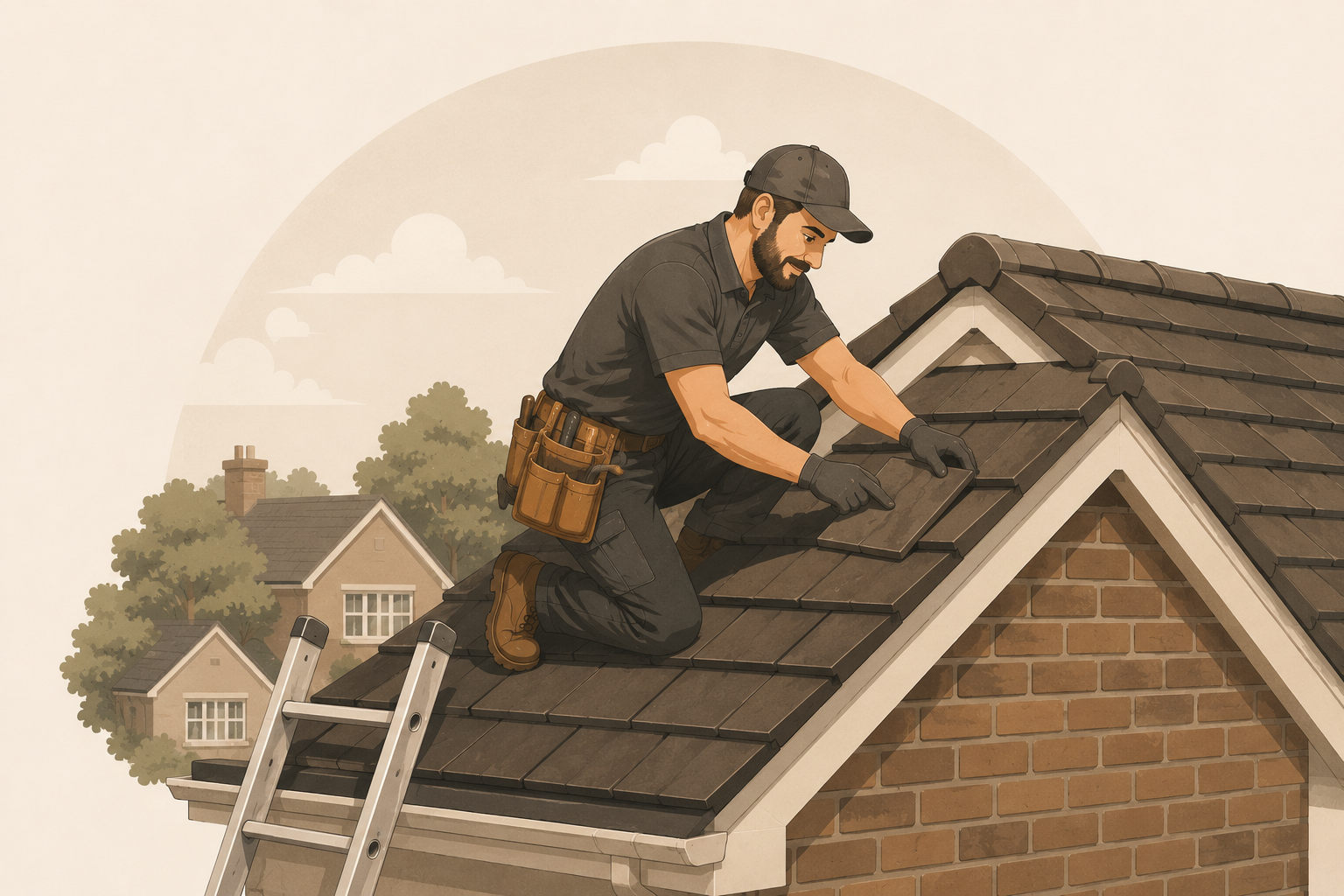
Picture a Bolton roofer pulling away from a quote. £7,500 for a full reroof in Astley Bridge. The customer's nodded along, taken your card, said "we'll be in touch." Then they go inside, open Google, and pull up two more roofers. Yours, plus two competitors. The one with the best website wins - even if their price is £200 higher. That's not a hypothetical. That's how four out of five high-ticket roofing jobs are decided in 2026.
Here's the short version: a proper roofer's website that actually wins you those shortlist conversations costs £2,000–£6,000 to build, plus £30–£90 a month for hosting and maintenance. That's a slightly bigger budget than most plumbers need, for a good reason - the photos, the trust signals, and the proof do more of the selling on a £8,000 job than they do on a £200 one.
The short answer (and where it lands)
Most roofers across Bolton, Westhoughton, Horwich, Farnworth, and Bromley Cross land in the £3,000–£5,000 range with a small specialist team. That covers strategy, real photography of recent jobs, copy that sounds like an actual roofer wrote it, location pages for the towns you cover, accreditations laid out properly, and the SEO setup to rank for "roofer Bolton" and similar local searches. Anything substantially below, and corners are getting cut. Anything substantially above, and you're paying for an office in central Manchester you'll never visit.
Why a roofer's website matters more than a plumber's
We've written about web design for plumbers in Oldham before. Roofers are a different game, for one simple reason: the size of the job.
A homeowner with a leaking radiator picks the first plumber who can come out today. They'll spend £150 and not lose much sleep over the choice. A homeowner staring at missing tiles after a Bolton storm is about to spend somewhere between £400 (a quick patch repair) and £15,000 (a full reroof on a four-bed semi). They will not pick the first roofer they find. They'll get three quotes. They'll cross-check websites. They'll read reviews. They'll look for accreditations they've never heard of and Google those too.
That extra research stage is where most roofers lose work without ever knowing why. You quoted fairly, you turned up on time, your reviews are decent - but the customer's already shortlisted you out, on a three-second glance at a website that looks like it was built in 2014.
On a £200 plumbing call-out, the website is a tiebreaker. On a £8,000 reroof, the website is half the sale. — Valoron
What it costs in Bolton: real numbers
These ranges are based on what roofers across Greater Manchester actually pay, not agency price lists. They reflect the gap between a website that exists and a website that closes a quote.
| Build type | Typical cost | Best for |
|---|---|---|
| DIY (Wix, Squarespace) | £0 + £15–£35/mo | Hobby or sole-trader work only. |
| Cheap freelancer | £400 – £1,200 | Almost no one. Skip it. |
| Local small specialist team | £2,000 – £6,000 | Most roofers across Bolton, Bury, Wigan, and surrounding areas. |
| City-centre Manchester agency | £7,000 – £18,000+ | Roofing companies with £1m+ turnover and a marketing team in-house. |
The big jump on this table is between cheap freelancer and small specialist team. That gap isn't pretty design - it's the strategy, the photography, the copy, and the SEO that turn a website from a brochure nobody reads into a sales tool that pulls quotes through to a yes.
Hertz reportedly paid Accenture over $32 million for a website that never even went live. A high spend is no guarantee of a good outcome. — Worth remembering
Five things that lose roofers jobs online
Before we get to what works, here's what's actively losing you work. We see all five on roofer websites across Greater Manchester every week.
1. Stock photos of perfect roofs
Every customer can spot a stock image. The pristine American-style roof on a sun-drenched suburb. The model in a hi-vis with white teeth. They scream "I haven't done a real job in months" louder than anything you could put in writing. If you can't show your own work, the customer assumes there isn't any worth showing.
2. No accreditations - or worse, fake ones
NFRC, CompetentRoofer, TrustMark, RoofCERT, FairTrades. A homeowner spending £8,000 knows to look for these. If the badges aren't there, you're competing on price alone. If they're there but you're not actually a member - it's a five-second job for a customer to verify on the NFRC's own site, and you've just lost the quote and your reputation in the same click.
3. A homepage that hasn't been touched since 2018
Old design isn't a neutral signal. It tells the customer you might not be around in five years if their guarantee needs honouring. That £50 WordPress theme you bought back in 2019? It's probably a security risk now too, which is its own problem.
4. Three reviews from 2020
Customers reading reviews are looking for two things: number, and recency. Three five-star reviews from four years ago is worse than ten three-star reviews from last month. You need both - quantity and freshness - and a system to keep them coming in.
5. A site that loads in 8 seconds on mobile
Over half of UK web traffic is on mobile, and for "roofer near me" searches it's higher. If your homepage takes more than three seconds to load, half the people tapping it have already gone back to Google.
You can spot a struggling roofer's website at twenty paces - one stock photo of an immaculate roof, a £200 Fiverr logo, four reviews from 2019, and a "Web Design by [a freelancer who left Upwork in 2021]" link in the footer. That's not a website, that's a fossil.
Five things that win roofers jobs online
These are in rough order of how much they move the needle. Get the first three right and the rest is icing.
1. A real photo gallery of recent jobs
Before-and-after photos of actual roofs you've worked on, in Bolton or nearby postcodes. No stock. Date them. Add the area. "Reroof, semi-detached, Astley Bridge BL1, March 2026." Customers can read between those lines: it's recent, it's local, it's a property type they recognise. That's the closest a website gets to the customer phoning the last person you worked for.
2. Accreditations and guarantees laid out properly
Every accreditation you actually hold, with the proper logo, on the homepage above the fold. NFRC, CompetentRoofer, TrustMark, RoofCERT, FairTrades, manufacturer guarantees you're certified to install (GAF, IKO, Marley, etc.). A line about your workmanship guarantee. A line about being insured up to £X. Customers spending £8,000 are buying peace of mind as much as a roof.
3. Local SEO that takes Bolton seriously
A dedicated location page for Bolton, plus pages for the surrounding towns you cover
- Westhoughton, Horwich, Farnworth, Bromley Cross, Little Lever, Kearsley. Real,
plain-English copy on each one, not a template with the town name swapped.
LocalBusiness → RoofingContractor schema markup so
Google understands what you actually do. A properly set-up Google Business Profile.
Citations on Checkatrade, TrustATrader, Yell, and the local Bolton directories.
4. Specific service pages, one per service
Not a single "what we do" page with a bullet list. A separate page for each main service so Google can rank you for each one independently:
- Full reroofing (residential)
- Roof repairs (slate, tile, flat)
- Storm damage repairs
- Flat roofing (EPDM, GRP, felt)
- Chimney repairs and repointing
- Gutter, fascia & soffit replacement
- Insurance work
- Commercial roofing
Each one is a search someone in Bolton is making this week. Each one without a dedicated page is a job you're not even being considered for.
5. Real reviews, surfaced properly
Pull reviews from Google, Checkatrade, and TrustATrader directly onto the homepage. Show the reviewer's name (where you have permission) and the date. Aim for at least twenty visible, and a steady drip of new ones every month. The system to ask for reviews is more important than the website itself - text every customer the day after the job, link them straight to your Google review form.
On a high-ticket job, the website doesn't sell. It removes the reasons not to call you back.
Who should actually build it?
Honest take, after hundreds of conversations with tradespeople:
- DIY builders (Wix, Squarespace) are a trap on roofing sites in particular. The photo-gallery functionality is shallow, the SEO ceiling is low, and the templates make every roofer look the same as every other roofer. Forty hours of your evenings doesn't equal a £4,000 build - it equals £4,000 of your time, plus a worse outcome.
- Cheap freelancers are a coin flip. Some are great. Most disappear within 12 months, and when storm season hits and your contact form breaks at 4am, there's no one to ring.
- Local small specialist teams are where most roofers in Bolton land for the right reasons: the personal contact of a freelancer, the skill range of an agency, none of the city-centre overheads.
- Big city-centre agencies earn their fees on enterprise work. For a 7-page roofing site, you're paying for an office in Spinningfields you'll never see.
- Offshore teams can work, with proper UK-side oversight. Without it, you'll spend the money you saved on fixing what came back.
The hidden costs nobody quotes you for
A common trap: a £1,800 build with £180/month "essential" support hidden in the small print. That's a £4,000 first-year website wearing a £1,800 sticker.
| Item | Realistic cost |
|---|---|
| Hosting & maintenance | £30 – £90/month |
| Domain renewal | £10 – £20/year |
| Branded email (Google Workspace) | £6/user/month |
| Photography (one shoot every 6–12 months) | £200 – £500 per session |
| SEO support (optional but recommended) | £250 – £700/month |
All in, a solid roofing website is roughly £3,500–£6,500 in year one, then £700–£1,500/year ongoing. Spread across the 8–15 high-ticket jobs a year a working website brings in, that's an investment, not an expense.
A £5,000 build that wins you two extra £6,000 reroofs has paid for itself before the first year is out. The maths on roofing websites is ridiculously kind once the phone starts ringing.
Quick checklist: is your roofer site doing its job?
Tick honestly.
- Loads in under 3 seconds on mobile.
- Phone number visible at the top of every page, click-to-call on mobile.
- A photo gallery of at least 12 real, recent jobs - dated and located.
- NFRC, CompetentRoofer, or whichever accreditations you hold, shown above the fold.
- Workmanship guarantee and insurance figure clearly stated.
- A page for Bolton, plus pages for the surrounding towns you cover.
- A separate page for each main service.
- At least 20 visible Google or Checkatrade reviews, with recent dates.
- Hosting and backups you actually understand.
- Shows up on the first page of Google for at least one "[service] Bolton" search.
Fewer than seven of those, and you're not losing the occasional job - you're quietly leaving £30,000–£60,000 a year on the table, depending on patch and average ticket size.
FAQ
How much does a roofer's website cost in the UK?
Realistically, £2,000–£6,000 for a proper build that wins jobs, plus £30–£90 a month for hosting and maintenance. Roofers usually need a slightly bigger budget than plumbers because the photo galleries, accreditations, and trust signals do more of the selling on a high-ticket job.
Why does a roofer's website need to be better than a plumber's?
Because the jobs are bigger and the customer does more research. A homeowner getting a £200 leak fixed picks a plumber on availability. A homeowner spending £8,000 on a reroof opens three or four roofer websites side-by-side and shortlists the ones that look professional, show real work, and have visible accreditations.
Should a Bolton roofer be on Checkatrade or build a website?
Both, in that order. Checkatrade and TrustATrader send you initial leads while your website's ranking. Long-term, your own website is the one piece of marketing you actually own - and it's where higher-value insurance and commercial jobs come from.
What accreditations should be on a roofer's website?
Whichever ones you actually hold, displayed clearly above the fold. Common ones for UK roofers: NFRC (National Federation of Roofing Contractors), CompetentRoofer, TrustMark, RoofCERT, FairTrades, plus any manufacturer guarantees you're certified to install. Don't list ones you don't have - it's a quick way to lose a job.
How long does it take to build a roofer's website?
Six to ten weeks, including a proper photo shoot of recent jobs, copywriting, design, build, and SEO setup. The photography is what usually adds time over a plumber's site - and it's also what wins the job, so it's worth doing properly.
Is it worth paying for SEO if I'm getting work from word of mouth?
Word of mouth is brilliant until it isn't. It's also unpredictable, hard to scale, and disappears when your best repeat customers move house. SEO gives you a second, steady stream of enquiries on top of referrals - and the people searching "roofer Bolton" on Google have no one to refer them, so you've got no competition from the personal recommendation.
Can I just use Facebook and Instagram instead?
Not for the bigger jobs. Social media is brilliant for showing off recent work and staying in front of past customers. But the homeowner spending £8,000 is on Google, not Instagram. Your website is where they decide if you're a real business worth phoning.
Last updated: May 2026. Prices reflect typical UK market rates and will vary by region, provider, and project specifics.